How Reverse Osmosis Works
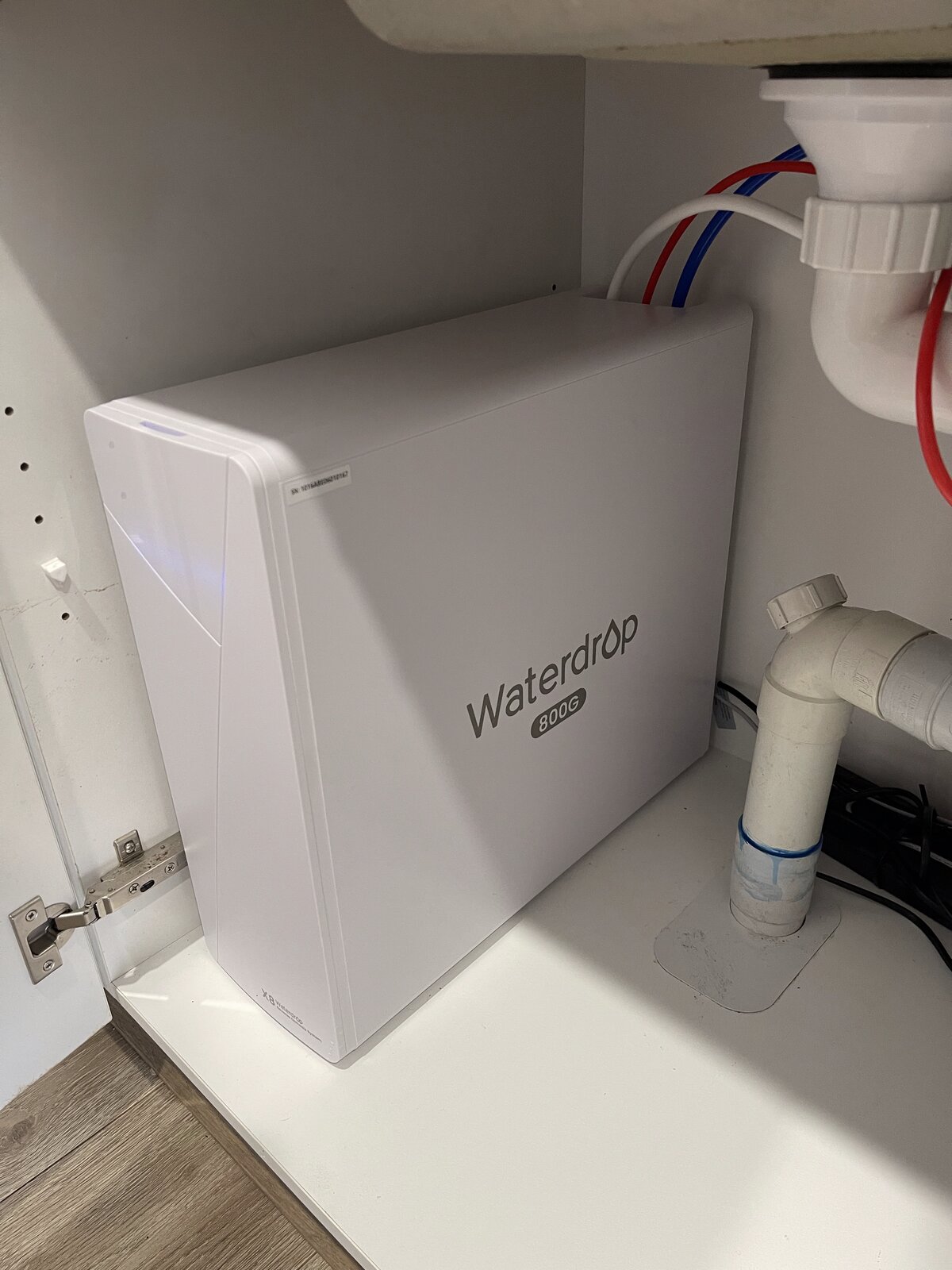
The photo above shows a Waterdrop 800G — a modern tankless reverse osmosis unit — installed under a kitchen sink in a Melbourne home. The compact white unit with its blue LED indicator is the RO membrane module. Colour-coded tubes feed it: supply water in, waste water out to drain, and purified water up to a dedicated filtered tap on the benchtop.
Reverse osmosis works by forcing water under pressure through an extremely fine semi-permeable membrane — typically 0.0001 microns. This removes dissolved solids including heavy metals, nitrates, fluoride, sodium, chloramines, and most other contaminants that particle filters cannot remove because they're dissolved rather than particulate.
The trade-off is waste water. For every litre of purified water produced, an RO system rejects 2–4 litres of concentrated wastewater to drain. Modern tankless systems like the Waterdrop 800G are more efficient than older tank-based units, but waste is still a factor. RO also filters slowly — it's designed for drinking and cooking water at a single tap, not for whole-house flow rates.
How Whole-House Filtration Works
A whole-house system (point-of-entry filter) installs where the mains supply enters the property. All water — at every tap, shower, appliance, and toilet — passes through the filter. These systems use physical media to remove particles: sediment filters catch suspended solids, and carbon block filters adsorb chlorine, chloramines, taste, and odour.
Whole-house systems do not use membranes and cannot remove dissolved solids like an RO system can. But they operate at full mains flow rate with no waste water. A properly sized Big Blue system has negligible pressure drop and treats thousands of litres per day without issue.
What Each System Removes
| Contaminant | RO System | Whole-House Filter |
|---|---|---|
| Sediment / rust / particles | ✓ Yes | ✓ Yes |
| Chlorine taste & odour | ✓ Yes | ✓ Yes |
| Chloramines | ✓ Yes | ~ Partially (carbon) |
| Heavy metals (lead, mercury) | ✓ Yes | ✗ No |
| Nitrates / nitrites | ✓ Yes | ✗ No |
| Fluoride | ✓ Yes | ✗ No |
| Dissolved salts / TDS | ✓ Yes | ✗ No |
| Bacteria & viruses | ~ Most (membrane) | ✗ No (needs UV) |
| VOCs / pesticides | ✓ Yes | ~ Partially (carbon) |
| Shower / bath water | ✗ No (single tap) | ✓ Yes (whole house) |
Which Should You Choose?
- Your main concern is drinking water quality
- You want to remove dissolved solids, fluoride, or heavy metals
- You rent or have limited space (under-sink units are compact)
- Melbourne tap water taste bothers you at the kitchen tap only
- You want the purest possible water for cooking and drinking
- Your concern is sediment, rust, or chlorine everywhere — not just drinking water
- You want filtered shower water for skin and hair
- Your hot water system and appliances need sediment protection
- You have a property with older galvanised pipes
- You want one maintenance point for the whole house
Melbourne's mains water meets Australian Drinking Water Guidelines and is generally considered safe. The most common complaints are chlorine/chloramine taste (especially in summer when dosing increases) and sediment in older pipe runs. For most Melbourne households, a whole-house carbon filter addresses these complaints without needing RO. RO makes sense when someone has specific health reasons for wanting ultra-low TDS water, or where heavy metals are a concern (rare in Melbourne's supply but possible in properties with old lead solder or fittings).
Can You Use Both?
Yes — and this is actually the best outcome for households that want both comprehensive protection and ultra-pure drinking water. A whole-house system removes the bulk sediment and chlorine (protecting the RO membrane and extending its life significantly), and the RO unit then polishes the water at the kitchen tap to near-laboratory purity.
Installing a whole-house pre-filter upstream of an RO unit extends the RO membrane's service life from a typical 2–3 years to 4–5 years or more, because the RO isn't doing the heavy work of sediment removal. The combination system is especially popular in Melbourne's inner eastern suburbs where properties have copper pipe and older supply infrastructure.
Installation — What's Involved
For an Under-Sink RO System
The system connects to the cold water supply under the sink and drains to the waste pipe. A separate tap is installed on the benchtop for filtered water. Tankless units like the Waterdrop 800G don't require a pressure tank, making installation cleaner and faster. It's a licensed plumbing job — the connections to mains supply and waste require compliant fittings.
For a Whole-House System
Installation is at the mains entry point — typically on the side of the house or in the garage. We cut the supply line, fit the filter housing with proper isolation valves, install a backflow prevention device (required by your water authority), and commission the system. A typical installation takes 3–4 hours. Filter cartridges need replacing every 6–12 months depending on usage.
For most Melbourne households: start with a 2 or 3-stage whole-house system to address the most common complaints (chlorine taste, sediment, appliance protection). If drinking water purity is a priority, add an under-sink RO at the kitchen tap. The combination gives you the best of both — whole-house protection and ultra-pure drinking water — at a sensible total cost.
Not Sure Which System Is Right for You?
Call us and we'll ask a few questions about your property and water concerns, then recommend the right system — without overselling. Fixed-price installation, licensed plumbers.